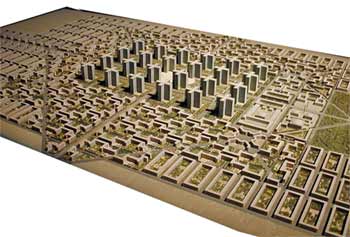
The idea was, in principle, simple: a city could be “compressed into an agglomeration of vertical extrusions in a limited location.” This had been done in Manhattan in the early 20th century, and the concept had crossed the Atlantic to Europe. In 1925, Charles-Édouard Jeanneret, better known as Le Corbusier, devised the Plan Voisin to restructure Paris.
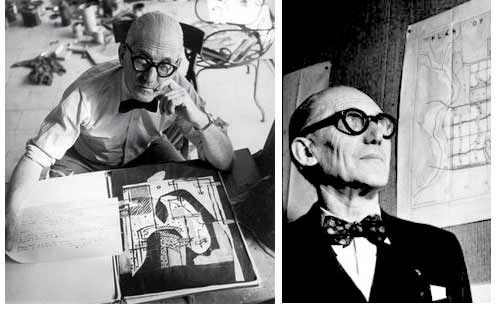
The Architect’s Idea: A “Medieval Relic”
For Le Corbusier, the urban center of Paris was too congested. He considered it small, old, and obsolete in the face of the intense road traffic of the rapidly modernizing twentieth century. For the architect, the city was stuck, a “medieval relic.” Spaces needed to be rationalized.
The Patrons of Le Corbusier
Watch our latest Shorts!
After being rejected for funding by Peugeot and Citroën, Le Corbusier found patronage in another car manufacturer, Gabriel Voisin. To carry out the plan, a significant part of historic Paris would need to be demolished. About forty hectares on the right bank of the Seine were deemed “unsanitary and outdated” and marked for clearance, including the areas around Les Halles market, Rue de Rivoli, and the Place de la Madeleine.
A massive highway would run through the area from east to west. Nearly 600-foot-tall (180 meters), cross-shaped, glass-facade buildings and sprawling green areas would replace what Le Corbusier considered “a dry scab.” His idea also included isolating historical monuments. The principle was not to destroy the past, but to rebuild around it. In the architect’s words: “The past is transformed into something that is no longer dangerous for life, but finds its true place within it.”
Le Corbusier’s Social Ideal: The Unité d’Habitation
Interestingly, Le Corbusier only once built tall residential buildings in France. It happened between 1946 and 1952, and it was called the “Unité d’Habitation.” Located some distance from the city center of Marseille, the building is eighteen stories high and surrounded by five hectares of parks. It housed apartments for 1,600 people and included facilities like a gym, a children’s pool, and a cycling track on its roof.
While some of these amenities fell into disuse over time, this building has always been pointed to as the personification of Le Corbusier’s social ideal: a structure designed to house its occupants in a healthy and communal way. Its rooftop has been considered one of the “rooftops of the world,” a space open to utopia, quite similar to the architectural spirit of Fourier, who in the 19th century laid the groundwork for utopian socialism.