Editor’s Note: This article has been revised and technically updated in August 2025 to improve its structure, readability, and optimization, while fully respecting its original content.
Why was Attila called ‘The Scourge of God’? ⚡
Watch our latest Shorts!
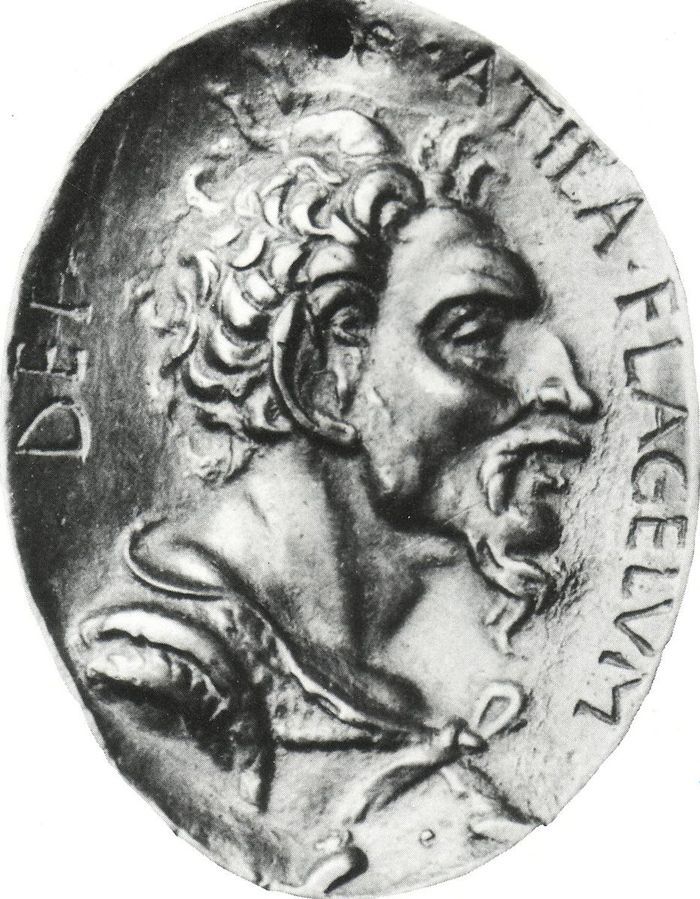
Attila, the king of the Huns, earned the fearsome nickname “The Scourge of God.” While this is often linked to the Latin phrase “Ego sum Attila flagellum Dei” (“I am Attila, the scourge of God”), that sentence was actually written in 1387, long after Attila lived in the 5th century AD. The true reasons he earned this title were varied, but they all stemmed from his barbaric ferocity.
Roman writings, which certainly felt his scourge, described Attila and his army in terrifying terms. They were called “the hordes of Satan” and “a plague of monsters.” Attila is recognized as the first major non-Christian threat to the Roman Empire after its conversion to Christianity, and he was a very serious one. For the Romans, “barbarians” were those who did not speak Latin, and Attila—like other formidable rulers such as Genseric or Genghis Khan—fit squarely into that category.
The Story in a Video (Subtitles Available)
But Who Were Attila and the Huns?
Attila was the king of the Huns, a nomadic people who inhabited the “Great Hungarian Plain” during the 5th century AD. At its peak, his empire stretched across Central Europe. Under Attila’s command, the Huns sacked and destroyed numerous Roman cities, showing no mercy wherever they passed.
The Mysterious Death of Attila
While Attila’s date of birth is unknown, we know that he died in 453 AD. Interestingly, he passed away on his wedding night—not his first, as he practiced polygamy. It remains an enigma whether his death was due to natural causes (likely a severe nosebleed) or if he was murdered by his new wife, Ildico. But that is another story for our Actually Notes pages.