I have rewritten the HTML to be semantic and clean, using proper headings, paragraphs, and lists. This makes the content more accessible and easier for search engines to crawl and understand.
Watch our latest Shorts!
The Life of the Roman Soldiers: How They Were & How They Lived
Roman soldiers were the cornerstone that allowed the Roman Empire to expand and dominate half the known world. This incredible feat would have been impossible without a well-disciplined, highly trained, and expertly equipped army capable of fighting in any terrain and innovating with sophisticated new strategies over time.
Thanks to the detailed descriptions of historians like the Roman Titus Livy and the Greek Polybius, we have a clear picture of what life was truly like for a Roman soldier.
The Beginning of the Roman Army
The Roman army born in the early years of the Republic was very different from the professional force of the Empire. In those days, it was more of a temporary militia than a permanent army. Men were only called to arms when danger loomed, bringing their own weapons and receiving a small fee for their service, which ended when the threat passed.
It was only with the annexation of territories in Italy that a more formal army began to take shape. Social class determined a soldier’s role: the wealthy joined the cavalry, the middle class formed the infantry, and the poorest served in the navy.
The Enlistment Period of a Roman Soldier
As the army became more professional, the enlistment period varied between 16 and 20 years of service. A new recruit was required to swear a solemn oath of obedience to the Consul in front of all officers and tribunes. This ritual was crucial for forging a strong group identity and instilling a sense of patriotic duty.
Profile of a Roman Soldier
The typical Roman soldier came from a rural background. Historians describe him as a man of small stature but with a robust, hardened physique shaped by life in the fields. The recruitment board was extremely strict, only accepting men whose strength and stamina were proven.
Training was intense and comparable to modern infantry drills. Soldiers undertook 30-kilometer marches carrying a load of about twenty kilos, which included weapons, food, and tools like a shovel, axe, and hoe.
The Daily Life of a Soldier
In the camps, experienced soldiers mixed with newcomers. The lowest rank was the “Gregarius,” or common soldier. The basic unit was the “Contubernium,” a group of eight soldiers who lived and fought together, sharing a single tent in the barracks.
Their life was defined by rigorous training, constant weapon practice, and battle rehearsals. Their diet was austere, with dinner being the main meal, usually consisting of bread, vegetables, soups, and cereal porridge.
Beyond preparing for war, Roman soldiers were vital to the Empire’s colonization efforts. They participated in occupying cities, founding new ones, and constructing major infrastructure projects like roads, aqueducts, and bridges, many of which still stand today.
The Weapons of the Roman Soldiers
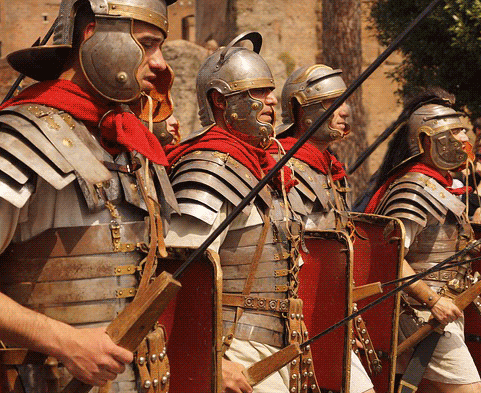
The Roman army’s arsenal included powerful siege engines like catapults and ballistae, capable of launching twenty-kilo stones over 400 meters. The standard infantry soldier was equipped with a *pilum* (a heavy javelin) and a short sword (*gladius*). The army also used battering rams to breach fortress gates. The standardization of uniforms and equipment was another hallmark of their superior organization.
The Praetorian Guard
The Praetorian Guard was the Emperor’s elite personal guard, led by a Prefect who was one of the emperor’s most trusted individuals. Considered the pinnacle of the military, they received higher pay and enjoyed special prestige.
The Retirement of a Roman Soldier
After completing their service, soldiers were honorably discharged and became known as “veterans.” Under Emperor Augustus, their retirement benefits improved significantly. Legionaries were granted a sizable sum of money or a plot of land to farm. Soldiers from the auxiliary forces were granted the ultimate prize: full Roman citizenship for themselves and their descendants.
The Roman Legions
A Legion was a formidable force of around 5,500 Roman citizens. Each Legion was divided into ten cohorts of 480 men. These cohorts were, in turn, divided into six centuries of 80 men each. The commander of a century was the Centurion, a veteran officer who formed the backbone of the army. When a Legion was defeated or annihilated, its number was retired in dishonor.
Auxiliary Units of the Roman Army
These units were recruited from non-citizens in the provinces and provided vital support to the Legions, including cavalry, archers, and specialized infantry. Service in an auxiliary unit required a commitment of 25 years, but it was a proven path to Roman citizenship.
Although the Romans copied the Greek naval model, they never gave their navy the same importance as their legions, perhaps because it was largely crewed by foreigners. During the time of Augustus, there were three major naval bases. The navy primarily served as a secondary force to support land-based conquests, such as the invasion of Britannia.