What is the Bible Code?
In the mid-1990s, Israeli mathematician Eliyahu Rips, with the help of a computer program, announced a bewildering discovery hidden within the sacred text of the Bible. He found encoded words that formed messages with a much lower probability of appearing by chance than random luck would allow. In essence, he claimed to have unraveled the secret code that has been sought in the Bible since ancient times.
Watch our latest Shorts!
In 1997, journalist Michael Drosnin wrote the bestseller “The Bible Code,” which introduced the world to these hidden messages that seemed to hold the key to humanity’s future. For both Rips and Drosnin, the Old Testament, a text over three thousand years old, contained messages about events that had already happened, were happening, and were yet to come. Few of them were positive.
The idea of a Bible code has been studied for centuries. Many great minds, including Sir Isaac Newton, dedicated part of their work to searching for it. For Newton, the Bible was “a cryptogram sent by the Almighty,” but the 17th-century scientist lacked the tools to extract its hidden “truth.” The Torah, the Old Testament, is composed of five books (Genesis, Exodus, Leviticus, Numbers, and Deuteronomy) and contains over 300,000 Hebrew characters.
How to Decode the Secret Content of the Bible
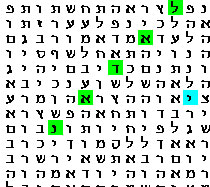
Unlocking the code required a powerful instrument capable of performing calculations quickly and systematically. Only today, thanks to computer science, can this task be performed. This is precisely what Rips’s mathematical team did. They created a computer program that searched for words in the biblical text by skipping a constant number of letters, a method known as Equidistant Letter Sequence (ELS).
This is similar to how Julius Caesar encoded his messages using the “substitution” method, replacing each letter with one three places down the alphabet. In the case of the Bible, Rips discovered that by jumping a constant number of characters, new words were formed that gave a new meaning to the text.
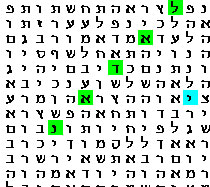
Rips’s program arranges the original Hebrew characters of the Bible into a grid, one after another, and then searches it like a giant word search puzzle, forming words that create an intelligible new message.
The code and the method for finding it were published in the prestigious journal “Statistical Science” in 1994. As one might expect, the discovery was subjected to multiple tests to determine its validity. One of these tests, conducted independently, searched for the names of thirty-two sages who lived after the biblical era. The results were astounding: the search found not only the names but also the dates of birth and death of all thirty-two wise men encoded in the text.
Harold Gans, a cryptologist from the U.S. National Security Agency, took the experiment further, initially disbelieving the findings. He searched for the names of the cities where the randomly chosen sages were born. The statistical probability of these cities being encoded on the same pages as the names was one in ten million. After conducting the search, Gans located the city names exactly where the theory predicted they would be. Similar experiments have been run on other lengthy texts, such as Tolstoy’s “War and Peace,” but in no other work were the coincidences as eloquent or repetitive as in the biblical text.
Fulfilled Predictions and Failures
Convinced that the code was real, Drosnin attempted to personally warn world leaders like Bill Clinton, Yasser Arafat, and Yitzhak Rabin of the findings. While searching the encoded text, Drosnin found a message that terrified him. Next to Rabin’s name, he found the phrase “assassin who will assassinate.” The journalist managed to deliver a letter warning of this prophecy to a friend of Rabin, but, as we know, it was to no avail. On November 4, 1995, Yitzhak Rabin was assassinated.
Drosnin continued to inform leaders of his findings. The day before September 11, 2001, he sent a letter to George W. Bush indicating that the Bible code pointed to a world war beginning with a major attack in the Middle East. He wrote that the words “Bush,” “Arafat,” and “Sharon” were coded together with the expression “end of days.” The code also seemed to speak the language of our present, using words like “atomic holocaust” and “world war,” which were unthinkable three thousand years ago.
However, not all predictions have come to pass. One prophecy that thankfully was not fulfilled was one Drosnin publicized based on the Hebrew calendar year 5766, which corresponds to the Western year 2006. According to his interpretation of the code, a great war involving Jews, Muslims, and Christians was supposed to begin with an attack on Jerusalem. Years later, we can verify that this did not happen.
Who Was the Encoder?
Despite errors in calculation and interpretation, if it is true that an encrypted message lies behind the words of the Bible, who was its author? For Rips, the discoverer of the code, the answer is God, who possesses a superior intelligence capable of knowing the future. Drosnin raises a more suggestive theory: Is it possible that the code is written in real time? Could the code be answering the questions that are asked of it at the precise moment they are asked?
According to tradition, God gave the Bible to Moses on Mount Sinai around 1200 BC. From that perspective, the code was already written, making God the encoder. For scholars of these arguments, there are collateral issues. Francis Crick, the co-discoverer of DNA, suggested that our DNA likely came from another planet, as the molecule is too complex to have evolved on Earth so quickly. A search in the Bible code gave Drosnin a curious result: “DNA was brought in a vehicle.” This seems to support the idea that life came to Earth from somewhere else, raising even more questions: from where, and why?
Teamwork to Unravel the Mystery of the Bible Code
A group of Spanish researchers adapted Eliyahu Rips’s program to Latin characters, creating a version that could search the five books of the Torah in Spanish. Their goal is to do something similar to the SETI program, which analyzes signals from outer space using the distributed computing power of volunteers. Through their “Cryptorah Project,” they aim to extend the search to anyone who wants to collaborate in unraveling the supposed secret code hidden in the Holy Scriptures.