Egyptian Hieroglyphics: A Sacred Script
The Ancient Egyptian Empire created a complex writing system using codes and symbols, which they embedded in the walls of their monuments. These symbols, known as hieroglyphs, were taken from the world around them. Sometimes a symbol would represent the object itself, but often it represented the sound of the word for that object, allowing the Egyptians to write out names and ideas that had no simple graphical representation.
Key Hieroglyphic Symbols and Their Meanings
The Scarab Beetle
Watch our latest Shorts!
For the Egyptians, the scarab beetle was a powerful symbol representing the sun god, Ra. They observed the beetle rolling a ball of dung, which they associated with the sun’s journey across the sky. The fact that its young emerged from this ball seemed to represent cyclical life and rebirth, a potent idea for a civilization so attuned to symbolic interpretations. The scarab beetle was a highly prized amulet for protection and regeneration.
The Mummy
The hieroglyph for a mummy began appearing around the Twelfth Dynasty (c. 2000 BC), although experts believe the practice of mummification is much older. The goal of mummification was to preserve the body so that the soul could survive in the afterlife. These elaborate funerary rites began some 6,000 years ago, and it is estimated that over 70 million bodies were embalmed throughout the history of Egyptian civilization. The practice also spread to other cultures, such as the Persians and Jews.
The Eye of Horus
This symbol, depicted as a stylized human eye, represents the falcon god Horus. The symbol comes from the myth in which Horus battled his uncle Seth for the throne of Egypt. During the fight, Seth tore out Horus’s eye, but it was later magically healed by Thoth, the god of wisdom. Because of this myth, the Eye of Horus came to symbolize healing, restoration, and protection. Like the scarab beetle, it was used extensively as a charm on sarcophagi and personal items.

The Phallus
Unsurprisingly, the phallus hieroglyph represented virility. It was always depicted as erect and circumcised. The presence of the phallus was often associated with a youth’s transition into adulthood. The Egyptians had many names for it, from medical terms to more popular ones like “the powerful” or “the beautiful.” Sexual vigor was revered and held religious significance.
The Rosetta Stone: Unlocking the Code
In the 6th century AD, the Byzantine Emperor Justinian banned the use of Egyptian writing, and the knowledge of how to read hieroglyphics was lost for over a thousand years. The Greek historian Diodorus Siculus had once aptly described it: “The Egyptian writing does not express concepts through syllables joined together, but through the meaning of the objects themselves.”
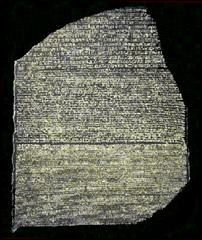
Many scholars over the centuries attempted to crack the code. The 17th-century priest Athanasius Kircher made significant contributions to the study of hieroglyphics. But the real breakthrough did not come until 1799, when a worker fortifying Fort Saint-Julien, near the town of Rosetta, discovered a large black basalt stone.
The Rosetta Stone, dated to 196 BC, was inscribed with the same decree written in three different languages: Egyptian hieroglyphics, Demotic (a popular script used in Egypt), and, crucially, ancient Greek. Since scholars could read Greek, they finally had a key to translate the other two incomprehensible scripts.
The real architect of the translation was Jean-François Champollion, a specialist in Oriental languages who studied the Rosetta Stone for over a decade. While an English physicist, Thomas Young, was able to prove that the names enclosed in ovals (called “cartouches”) could be translated as “Ptolemy” and “Alexander,” it was Champollion who successfully translated the full text. He discovered that the decree was written to honor the Egyptian king Ptolemy V.
According to Egyptian tradition, writing was a gift taught to humans by the gods. Through the centuries, many of the three hundred signs of the Egyptian script were believed to hold magical powers. Thanks to the Rosetta Stone, those powers could finally be understood once more.