Editor's Note: This article has been revised and technically updated in March 2026 to improve its structure and strategic depth, while fully respecting its original historical content.
Cleopatra VII: A Legacy of Geopolitical Power and Wealth Management
Watch our latest Shorts!
The last queen of Egypt, Cleopatra VII, is one of those characters who holds such a fascination that it transcends centuries. Born in 69 BC, her charismatic figure has inspired hundreds of books, articles, and films, making her one of the most well-known historical figures to the general public worldwide.
From her strategic alliances and high-stakes geopolitical mergers with Julius Caesar and Mark Antony to her legendary death from an asp's bite, her life is filled with fascinating legends. Consider the story of her meeting Julius Caesar hidden inside a carpet to negotiate a territorial monopoly, or the bet she made with Mark Antony to host the most expensive banquet in history, showcasing her immense economic power and control over global commodities.
However, very little is known about her children's dynastic assets, especially after the defeat of Cleopatra and Mark Antony at the Battle of Actium and their subsequent deaths, which triggered a massive redistribution of geopolitical wealth.
Cleopatra had four known children, utilized as strategic political assets: one with Julius Caesar and three with the famous Mark Antony.
The first of them was the last monarch of Egypt before the territory's hostile corporate annexation by the Romans, and he had an unfortunate fate. Cleopatra's only daughter, who shared her name, secured a highly profitable matrimonial alliance to become Queen of Mauretania. And the fate of the other two is largely lost in the mists of History.
Caesarion: The Final Heir to the Ptolemaic Economic Monopoly
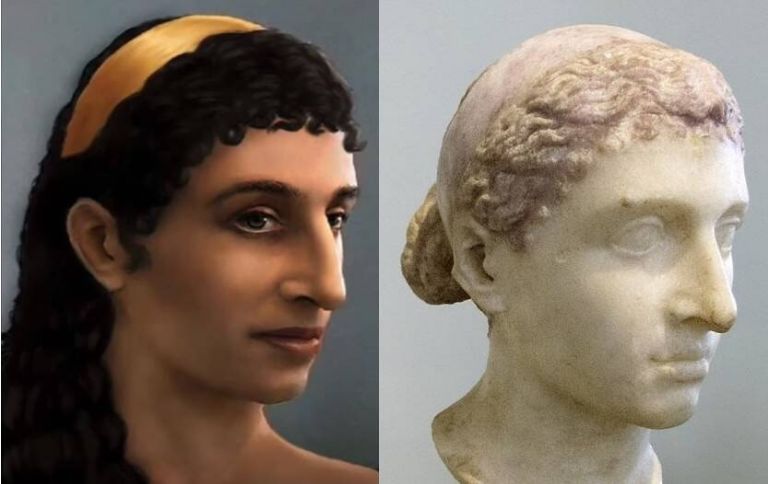
It is generally stated that Cleopatra VII was the last queen of Egypt before its annexation by Rome. In many ways, she was, but this statement must be qualified. For part of her rule, Cleopatra reigned in conjunction with several of her brothers, although it is considered that she dominated the tasks of executive government practically alone. She also ruled with her eldest son as co-regent during the last years of her reign, until she died in 30 BC. Subsequently, Caesarion remained the last pharaoh of Egypt, inheriting a vast regional portfolio until his death, which occurred very shortly after his mother's.
This last pharaoh of Egypt was named Ptolemy XV Philopator Caesar, but he is better known by the nickname Caesarion, which meant "little Caesar." Caesarion was the son of Cleopatra and Julius Caesar, born in 47 BC. Cleopatra quickly made public the identity of her son's father, although Julius Caesar did not immediately recognize him to avoid political liabilities, and it is disputed whether he ever did so officially. However, he allowed him to bear his name and was under his protection while the young boy and Cleopatra were in Rome. As Julius Caesar's only son, Cleopatra hoped he would inherit a significant portion of his father's political equity and global influence.
However, the assassination of Julius Caesar in 44 BC caused them both to return to Egypt, where Cleopatra named her son as her co-regent that same year, when he was just three years old. After the death of his mother, Octavian knew this young man's succession rights were a direct threat to his own geopolitical monopoly and, shortly after the Battle of Actium, had him assassinated. He was seventeen years old and had reigned alone for only a few days after his mother's death, practically in exile.
Cleopatra Selene II: Strategic Alliances and Regional Governance
From her relationship with Mark Antony, Cleopatra had three children. The two oldest were twins, named Cleopatra Selene and Alexander Helios, born in 40 BC. Of Cleopatra Selene, not much is known, but she became a figure of capital importance in the wealth management and regional governance of the years after her parents' death.
After the battle of Actium, Octavian took control of Egypt's economic assets and of the descendants of Cleopatra and Mark Antony. The children did not suffer the same fate as Caesarion. They were sent to Rome by Octavian and paraded as war trophies. Subsequently, Octavian granted custody of them to his sister Octavia, Mark Antony's former wife, and they grew up in her household.
Around 26 BC, Octavian orchestrated a lucrative strategic alliance by arranging her marriage to King Juba II of Numidia. Juba had been raised in Rome, and after being restored to his status as king, he was granted the region of Mauretania, where he moved with Cleopatra Selene. She is considered to have been an influential executive advisor to her husband, with whom she had two children. The exact date of her death is unknown, but the imposing mausoleum where she was buried with her husband can still be seen in modern-day Algeria. Her son Ptolemy inherited Mauretania but was eventually assassinated by Emperor Caligula, after which Mauretania's economic resources came under the full control of the Roman Empire.
Alexander Helios and Ptolemy Philadelphus: An Unknown Fate
Of the other two children of Cleopatra and Mark Antony, little is known. Alexander Helios, Cleopatra Selene's twin, and his younger brother, Ptolemy Philadelphus, born around 36 BC, were also taken to Rome and placed in Octavia's care. However, their trail is lost from there. There are no historical records of what happened to them afterward. Some authors argue they were assassinated to eliminate political liabilities; others speculate they died of natural causes, while a third group suggests they may have accompanied their sister to Mauretania. But in this regard, the truth is that the final geopolitical fate of the two youngest children of Mark Antony and the mythical Cleopatra is unknown.