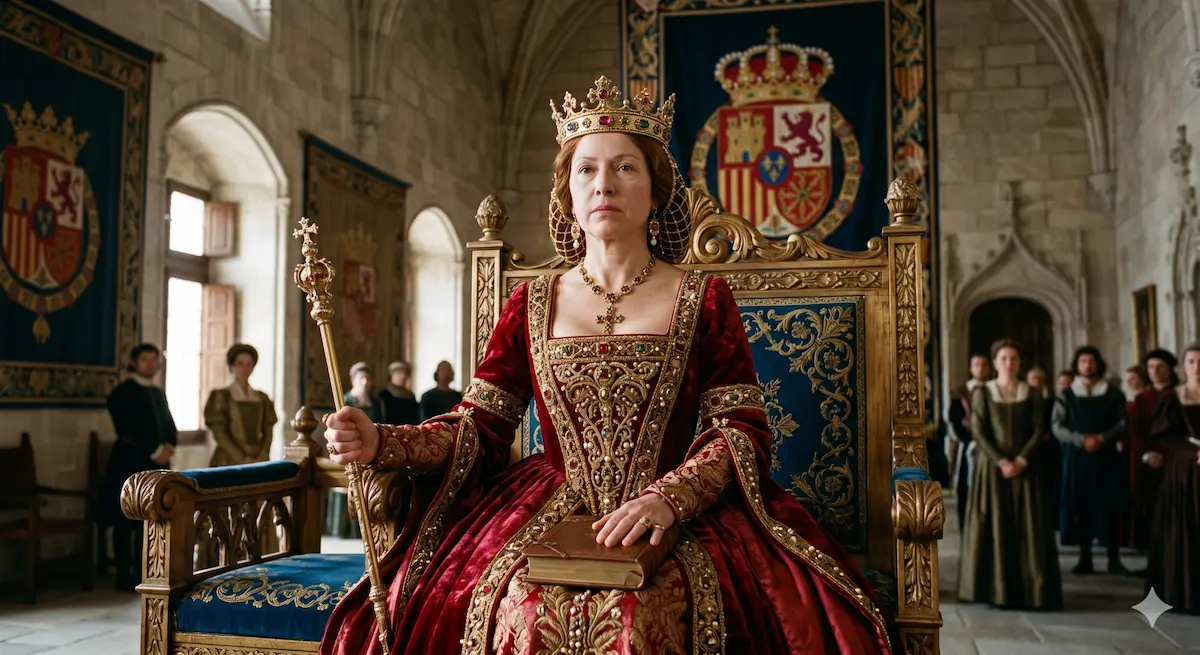
The year 1492 marked the zenith of the reign of Isabella I of Castile and Ferdinand II of Aragon. However, the much-desired territorial and religious unification brought with it one of the most drastic decisions with the greatest economic and demographic impact in the history of Spain.
Watch our latest Shorts!
This centralist vision led to the implementation of forced assimilation policies that culminated in the expulsion of Jewish communities and, subsequently, the mandatory conversion or exile of Muslims. Let’s analyze how these decisions were made and the deep scars they left on the socioeconomic structure of the time.
The Myth of “Convivencia” and the Precedent of 1391
Medieval Spain is often idealized as a paradise of the three cultures (Christians, Jews, and Muslims). However, this coexistence was always marked by tension, segregation into specific neighborhoods (juderías and morerías), and the payment of special taxes.
The real breaking point for the Jewish community was not 1492, but a century earlier. The pogroms of 1391, a wave of massive anti-Semitic violence that began in Seville and spread throughout the peninsula, caused the first great wave of forced conversions. This event created a new and complex social class: the Judeo-conversos or New Christians, who soon began to climb the ranks of the nobility, the clergy, and the administration, arousing the suspicion of the “Old Christians”.
The Obsession with “Purity of Blood” and the Inquisition
The expulsion cannot be understood without the creation of the Tribunal of the Holy Office of the Inquisition in 1478. Unlike the medieval Inquisition (controlled by the Pope), the Spanish Inquisition answered directly to the Catholic Monarchs, becoming the first state organ with jurisdiction over all their kingdoms.
Its official goal was not to persecute Jews or Muslims (over whom it had no jurisdiction), but to hunt down heretics or Judaizers: New Christians who, supposedly, continued practicing their old faith in secret. This gave rise to the infamous Purity of Blood Statutes (Estatutos de Limpieza de Sangre). For centuries, to access the university, public office, or military orders, a Spanish citizen had to prove that their lineage had no “stain” of Jewish, Moorish, or heretical blood, creating a paranoid society based on denunciation.
1. The Edict of Granada: The Expulsion of the Jews (1492)
The Jewish presence in the Iberian Peninsula (Sepharad) dated back to the times of the Roman Empire. For centuries, they had been a fundamental engine in administration, medicine, commerce, and banking. However, the pressure of the Spanish Inquisition and figures like the Inquisitor General Tomás de Torquemada, convinced the monarchs that coexistence was a risk to the faith of the New Christians.
On March 31, 1492, the Catholic Monarchs signed the Edict of Granada (or Alhambra Decree). The conditions were ruthless:
- Timeframe: The Jews had barely four months to leave the territories of the crowns of Castile and Aragon.
- Assets: They were allowed to sell their properties, but they were strictly forbidden to take gold, silver, minted coins, or horses out of the kingdom, forcing them to accept devalued promissory notes or sell their assets at a loss.
- The alternative: The only way to avoid exile was to receive Christian baptism.
Demographic consequence: It is estimated that between 50,000 and 100,000 Jews chose exile, scattering across North Africa, the Ottoman Empire, and the rest of Europe. These exiles, known as Sephardic Jews, preserved the Spanish language (Ladino) and customs for centuries.
2. From the Capitulations to the Pragmatic Sanction of 1502
The fate of the Muslim population (the Mudéjars) followed a different path, though with a similar outcome. After the surrender of Granada on January 2, 1492, the Capitulations of Granada explicitly guaranteed the right of Muslims to preserve their religion, their properties, and their customs.
However, the impatience of the ecclesiastical hierarchy to Christianize the new territory, led by the inflexible Cardinal Cisneros, resulted in forced conversions, the burning of Qurans, and severe cultural repression. This triggered the Rebellion of the Alpujarras (1499-1501).
Under the pretext of this uprising, the monarchs considered the Capitulations broken. On February 14, 1502, Isabella the Catholic promulgated a Pragmatic Sanction that forced all Muslims in the Crown of Castile to choose between conversion to Catholicism or expulsion. The vast majority, tied to their lands, opted for a feigned baptism, becoming known as Moriscos.
The Fate of the Exiles: The Sephardic and Morisco Diaspora
The impact of the exile forced thousands of families to embark on dangerous routes into the unknown, facing pirates, diseases, and extortions:
- The Sephardic route: Most initially fled to the neighboring kingdom of Portugal (from where they would also be expelled in 1497) or to North Africa. However, the great refuge was the Ottoman Empire. Sultan Bayezid II welcomed them with open arms, aware of the immense technical and commercial value they brought. To this day, the romantic tradition persists among Sephardic families who keep the key to the house from which they were expelled in Toledo or Córdoba.
- The tragedy of the Moriscos: After the forced conversions of 1502, the Moriscos lived under constant suspicion of allying with Barbary pirates or the Ottoman Empire. They were forced to abandon their language (Algarabía), their traditional clothes, and their public baths. This unsustainable pressure erupted in the War of the Alpujarras (1568-1571) and culminated tragically in 1609, when King Philip III ordered their total expulsion. It is estimated that about 300,000 Moriscos were deported, mainly to the Maghreb.
3. The Economic Impact and the Legacy of the Void
The expulsion of religious minorities had a devastating structural cost for the finances and the productive economy of the monarchy:
- Loss of human capital: The departure of the Jews meant the loss of international credit networks, highly trained physicians, specialized artisans, and efficient tax collectors.
- Agricultural crisis: Subsequently, the pressure on the Moriscos left vast extensions of irrigated orchards in Valencia and Aragon depopulated, collapsing agricultural production.
The pursuit of ideological homogeneity strengthened the power of the Crown and the Inquisition, but in the long run, it deprived Spain of a solid commercial bourgeoisie, laying the foundations for the financial crises that would devastate the empire in the coming centuries.
The Great Myth of Sephardic Surnames: Colors, Trades, and Cities?
One of the most widespread historical myths today—amplified by viral lists on the internet—is the belief that the Jews who remained in Spain and converted to Christianity (the Judeo-conversos) were forced by law to change their surnames to names of colors (Blanco, Bermejo, Rubio), trades (Zapatero, Herrero), elements of nature (Pino, Flores), or cities (Toledo, Sevilla).
The historical reality is diametrically opposed: there was never any law, royal decree, or Inquisition ordinance that forced converts to use a specific type of surname to be identified. In fact, the sociological goal of the conversion was exactly the opposite: total assimilation and camouflage within Christian society.
1. The True Origin of Color Surnames
In the peninsular Middle Ages, surnames were still in a phase of consolidation. A large part of the population acquired their surname from a very characteristic nickname or physical trait. The surname Bermejo, for example, comes from the Latin vermiculus (red) and was used as a nickname to describe a red-haired person or someone with a very ruddy complexion. The same was true for Blanco, Rubio, or Moreno.
These descriptive nicknames were used quite normally by the Old Christian population centuries before the expulsion of 1492. A red-haired Old Christian was called “Bermejo” by his neighbors exactly the same as any other person with that trait.
2. What Surnames Did Converts Actually Adopt?
When a Jew decided to convert to Christianity to avoid exile, they had to undergo the sacrament of baptism. Ecclesiastical and social tradition dictated that the convert adopted the surname of their baptismal godfather.
Given that Judeo-conversos needed to integrate quickly into the spheres of power and dispel any suspicion from the Inquisition, they sought high-status godfathers among the nobility, the high clergy, or Christian families of great prestige and impeccable “purity of blood.” Therefore, the vast majority of Judeo-conversos ended up bearing the most noble and traditional surnames of Castile and Aragon:
- Noble surnames: Mendoza, Guzmán, Toledo, Enríquez, or Zúñiga.
- Common patronymics: García, López, Pérez, Rodríguez, Fernández, or Gómez.
3. Toponymic or Botanical Surnames
Another very common mistake is believing that geographical surnames (Toledo, Córdoba, Valencia) or those related to botany (Manzano, Peral, Olmo) are exclusively of Jewish or converso origin.
The adoption of toponymic surnames was the most logical and common formula for anyone who migrated from one town to another. If an Old Christian named Juan moved from Toledo to Madrid, his new neighbors would quickly identify him as “Juan, the one from Toledo,” eventually consolidating as Juan Toledo. Christians, Jews, and Muslims all used this same system of geographic identification.
Historical conclusion: The famous “lists of Sephardic surnames” that circulate online lack documentary rigor. Although there were converts whose surname was Blanco, Bermejo, or Toledo, they did so by inheriting the name of their Christian godfather, by their place of origin, or by a physical trait; never as a legal imposition. Bearing one of these surnames today is not a reliable or demonstrable indicator of Jewish ancestry.