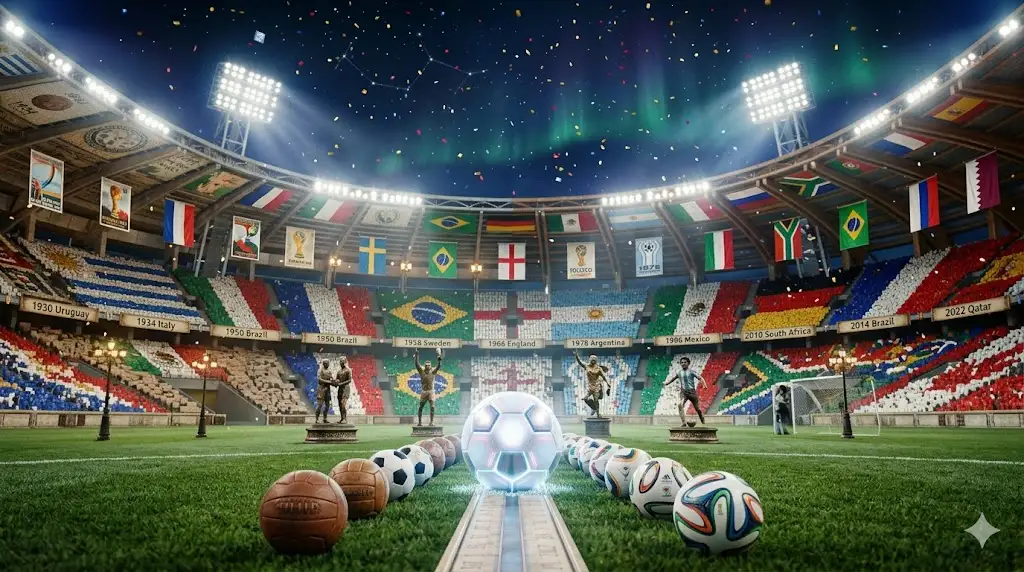
Uruguay 1930 World Cup History

Celebrating the centenary of the Oath of the Constitution of Uruguay (commemorating the country’s first constitution), this nation emerged as the organizer of the first Football World Cup in history. Times were different, of course; there was no mascot, and many countries could not participate due to the economic crisis devastating Europe. Well, regarding cyclical crises, times do not seem to have changed much.
Watch our latest Shorts!
Only France, Belgium, Romania, and Yugoslavia participated from Europe. The curious case was Egypt, who requested an extension for the tournament to be held later than July 13 to 30: the long boat trip prevented them from arriving on time. The extension was not granted, and they stayed home.
Some matches barely had 300 spectators; however, 93,000 attended the final. The doors opened six hours early for an 8:00 PM match, but by 12:00 noon, the stadium was packed.
How much do you remember about World Cup History?
From the first ball rolling in Uruguay 1930 to the modern era of VAR and goal-line technology, World Cups have left us unforgettable moments. Are you a true football encyclopedia? Take our two ultimate tests below!
⚽ Vintage Football Challenge: Prove you know the history of the beautiful game. Maradona, Pelé, historic goals... Only the true veterans score 10/10!
🔥 Modern Era Challenge (2014-2022): Messi, Mbappé, VAR, and the 7-1. Do you have a good short-term memory? Prove you are a modern football fanatic!
Uruguay, also the Olympic champion, won the World Cup. The following day was declared a national holiday in the country, showing the social significance of the event.
Italy 1934 World Cup History

The presence of Benito Mussolini in power marked the course of the 1934 World Cup in Italy. And his presence was not just a figure of speech; the dictator made himself noticed in all the matches and, like a good fascist, used and praised the Italian national team, the “azzurra,” as a matter of national pride. There is talk of his enormous influence in helping Italy reach the final and win it.
Uruguay returned the favor of the European boycott they suffered four years earlier by not attending this World Cup.
This championship belonged to Zamora, considered one of the best goalkeepers of his time, if not the best. A player with character who surprised everyone with his elbow clearances, known as “zamoranas.”
The anecdote was provided by Poldi Kielholz, a Swiss player who was the first to take the field wearing glasses. He scored three header goals; we don’t know how many pairs of glasses he went through during the World Cup.
France 1938 World Cup History
Like a dark omen, the rumor of the Second World War loomed. The sport was not oblivious to the grave situation that would soon break out globally, as this championship would open a gap until 1950 before another Football World Cup was held.
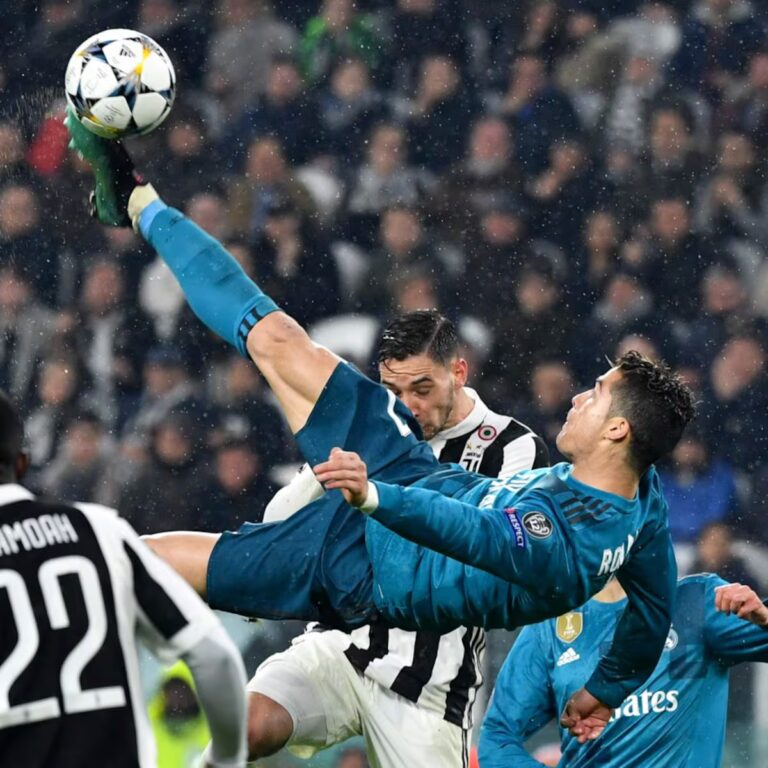
This was the World Cup of Zsengeller and Sarosi, two Hungarian players who scored eleven goals. A great Hungarian team began to emerge. It was also the tournament of ‘Peppino’ or ‘El Balilla’, Giuseppe Meazza, the leader of the victorious Italian team. The top scorer was Leônidas, who was also the inventor of the ‘bicycle kick’, a fast move practiced today by players like Cristiano Ronaldo. They called him the ‘Black Diamond’ or ‘Rubber Man’ for his extraordinary dribbling skills.
The controversy was sparked by Argentina, Uruguay, the United States, Costa Rica, El Salvador, Mexico, Colombia, and Dutch Guiana—teams that refused to participate. They protested because the World Cup was being played in Europe again, when alternating host continents had always been the plan.
Brazil 1950 World Cup History

Their famous attacking mentality, Brazil’s typical style of play, and the excellent tournament they were having made them the favorites to win the 1950 World Cup as the ghost of World War II faded. However, Germany was not invited.
As mentioned, everything pointed to Brazil becoming the champion. On the streets on the day of the final, July 16, 1950, a carnival was organized in the Brazilian capital. Maracanã saw its capacity filled with over 173,000 spectators, something unthinkable today.
Only 13 national teams attended the event. Italy suffered a terrible tragedy, losing the core of their team when the Torino squad almost entirely perished in a plane crash. Ten players from the national team died. Despite this, Italy participated.
In the final, after a goalless first half, Brazil scored midway through the second. However, Uruguay managed to tie, and just eleven minutes before the end of the match, they scored the winning goal against all odds. Since that moment, the term “Maracanazo” (in Portuguese: Maracanaço, translating to “The Maracanã Blow”) has become not only an adjective to describe that match and Brazil’s unexpected defeat but a synonym for a highly publicized and completely unexpected sports upset.
Sweden 1958 World Cup History

A very young Pelé, “O Rei Pelé,” was born as a football legend in the ’58 World Cup in Sweden. He outshone the figure of the Frenchman Just Fontaine. However, Fontaine managed to be the tournament’s top scorer with a total of thirteen goals.
For the first time, the World Cup could be seen on television in all participating continents.
A tragic event marked the fate of this World Cup for the English team: the plane crash suffered by Manchester United in Munich, which deeply affected the social sentiment of those generations. This fact was present in the championship, and specifically for the English team, which understandably failed to pass the first round.
This was undoubtedly Brazil’s World Cup. With Vavá, Didí, Garrincha, Pelé, and Zagallo, they demonstrated overwhelming superiority.
It was also the first World Cup without Jules Rimet; the promoter of the Football World Cups had passed away two years earlier.
More than just an anecdote was the refusal of Arab countries to play the qualifying matches due to Israel’s presence in that preliminary phase. The solution FIFA found was for Israel to play against the second-best national team from the European group. Belgium refused to play. In the end, Wales faced Israel; a 4-0 aggregate score sent Wales to the Swedish World Cup.
1958 World Cup Final. Sweden
SWEDEN 1958. Results
1. Brazil
2. Sweden
3. France
4. Federal Republic of Germany
Golden Boot: Just FONTAINE (FRA)
Best Young Player: PELÉ (Edson Arantes do Nascimento) (Brazil)
The Final in goals: Brazil 5 – Sweden 2 
Vavá 9′ and 32′
Pelé 58′ and 90′
Zagallo 68′
Liedholm 3′
Simonsson 80′
Chile 1962 World Cup History
A total of sixteen national teams gathered in Chile. With Pelé absent for almost the entire tournament, attention focused on Garrincha, who otherwise might have gone more unnoticed. Garrincha was the top scorer, along with five other players, with a low tally: only 4 goals.
The biggest controversy of the World Cup was the violent match played between Italy and the host nation, Chile. Described by the press as the stupidest exhibition in the history of football, the match was preceded by controversy over the degrading and dismissive treatment the Italian media had dedicated to Chile.
The bitterness transferred to the pitch, and scuffles between the players of both teams occurred throughout the match.
Two expulsions from the Italian team in twelve minutes speak for themselves. Furthermore, law enforcement had to forcibly remove Giorgio Ferrini from the field, as he refused to leave. Kicks to the head, recurring fights, and police intervention summarize this spectacle that shamefully crossed sporting boundaries.
The final, played between Czechoslovakia and Brazil, ended up being a walk in the park for the latter, despite conceding the first goal of the match. Ultimately, the result was three goals to one, even without the participation of Pelé, who would have been the star of the previous 1958 World Cup.
CHILE 1962. Results
1. Brazil
2. Czechoslovakia
3. Chile
4. Yugoslavia
Golden Boot:
Florian ALBERT (HUN), Valentin IVANOV (URS), Drazen JERKOVIC (YUG), Leonel SANCHEZ (CHI), VAVA (BRA), GARRINCHA (BRA)
Best Young Player: Florian ALBERT (HUN)
The Final in goals: Brazil 3 – Czechoslovakia 1
0:1 Josef Masopust (15.)
1:1 Amarildo (17.)
2:1 Zito (68.)
3:1 Vava (77.)
England 1966. Football World Cup

This World Cup will always be remembered for the controversial goal, the fifth of the final, by Geoff Hurst, which put the English team ahead on the scoreboard.
As can be seen in the video, it wasn’t really a goal; the ball did not cross the line. Although the English scored another goal, leaving the final at 4-2, that goal by Geoff Hurst was decisive.
The end of the controversy over the goal was provided by the Department of Engineering at the University of Oxford. According to a metrological study, it was concluded that the ball did not fully cross the line; it was six centimeters away from being a goal.
The ’66 World Cup in England belonged to Eusébio, “The Black Panther of Mozambique,” the tournament’s top scorer who catapulted his national team, Portugal, to third place. It was also the World Cup of Bobby Charlton, who won the particular “battle” against the “Kaiser,” Franz Beckenbauer.
The Mascot: Willie

A mascot debuted in this World Cup, Willie, a lion that they said represented “bravery” and “strength.”
Another anecdote of the championship was provided by the Mexican national team goalkeeper, Antonio Carbajal, who played his fifth championship, something only later achieved by Lothar Matthäus. Carbajal, moreover, has become the most scored-against goalkeeper: twenty-five goals in eleven matches. Too much exposure to risk…
England 1966. Results
1. England
2. Federal Republic of Germany
3. Portugal
4. Soviet Union
Golden Boot: EUSEBIO (Eusebio da Silva Ferreira)
Best Young Player: Franz BECKENBAUER (Germany)
The Final in goals: England 4 – Federal Republic of Germany 2
0:1 Helmut Haller (12.)
1:1 Geoff Hurst (18.)
2:1 Martin Peters (78.)
2:2 Wolfgang Weber (90.)
3:2 Geoff Hurst (98.)
4:2 Geoff Hurst (120.)
Mexico 1970 World Cup History
Society, without knowing it, was beginning to become globalized. And football was a living example, as even schedules were adapted so that all countries could watch the championship on a universalized television, present in the homes of the new middle classes.

Mexico ’70 was Pelé’s last World Cup. The German Gerd Müller conquered his first World Cup Golden Boot in Mexico by scoring 10 goals, three more than the Brazilian Jairzinho—the only player to have scored in every match of a World Cup—and five more than the Peruvian Teófilo Cubillas.
The Mexico 70 Mascot: Juanito

The championship mascot was “Juanito,” a boy wearing a typical Mexican sombrero with a ball under his foot. The ball with which the matches were played was sponsored for the first time. It was the ‘Telstar‘ by Adidas.
This was the last World Cup in which the trophy was the Jules Rimet Cup, a trophy that the Brazilian team kept permanently after winning it for the third time. For this reason, a new trophy was created for the following World Cup in Germany ’74.

As an anecdote, the feat of Franz Beckenbauer remains in memory, who in the semi-final stayed on the field despite having a dislocated shoulder.
The image of his arm in a sling is an icon of football’s epic nature.
Mexico 1970. Results
1. Brazil
2. Italy
3. Federal Republic of Germany
4. Uruguay
Golden Boot: Gerd MÜLLER (GER)
Best Young Player: Teófilo CUBILLAS (PER)
The Final in goals:
Brazil 4 – Italy 1 
Pelé 18′
Gérson 68′
Jairzinho 71′
Carlos Alberto 86′
Boninsegna 37′
Germany 1974 World Cup History
Germany ’74 was the World Cup of Total Football practiced by the team captained by Johan Cruyff.
All players attack and all players defend. In this championship, the trophy also changed its shape; it was renamed the “FIFA World Cup“, replacing the Jules Rimet Cup. The design of the trophy was handled by the Italian Silvio Gazzaniga.

In the final, the Dutch took the lead right at the beginning of the match thanks to a penalty kick converted by Johan Neeskens.
Everything was resolved in the first half: in the twenty-fifth minute, Paul Breitner tied the game also from a penalty, and two minutes before the end of the first half, Gerd Müller gave the victory to the tournament hosts, who had just won the 1972 European Championship.
Besides Beckenbauer and Cruyff, this was the World Cup of the player known as ‘Der Bomber’ Müller. Combined with the previous World Cup in Mexico, he managed to score fourteen goals (ten in Mexico and four in Germany). He held the record until 2006, but a superior Ronaldo snatched it away in Germany 2006 with 15 goals.
“Tip and Tap” were the mascots of the ’74 World Cup

“Tip and Tap” were the mascots of the ’74 World Cup. These two boys represented the divided Germany. With a smile on their faces, one was tall and blonde with the number 74 on his shirt, the other short and dark-haired with the initials “WM” on his shirt, which meant ‘Weltmeisterschaft‘, World Cup.
Germany 1974. Results
1. Federal Republic of Germany
2. Netherlands
3. Poland
4. Brazil
Golden Boot: Grzegorz LATO (Poland)
Best Young Player: Wladyslaw ZMUDA (Poland)
The Final in goals:
Federal Republic of Germany 2 – Netherlands 1
0:1 Johan Neeskens (2.) (Penalty)
1:1 Paul Breitner (25.) (Penalty)
2:1 Gerd Müller (43.)
Argentina 1978 World Cup History

Since 1962, no Football World Cup had been played in the Americas. This was Kempes’ World Cup, who was the top scorer, even though he didn’t score any goals in the first round. He finished the competition with six goals.
The dictatorship established by General Videla and the accusations regarding human rights violations in Argentina caused reluctance among many other national teams who showed their refusal to attend the championship. And players too. The most famous case was Cruyff, whom we did not see in the final because he refused to travel to Argentina. Finally, all the qualified teams attended the World Cup, but the opinion of an Argentine player, victorious in the final against the Netherlands, is enlightening: “It hurts to know that we were an element of distraction for the Argentine people while atrocities were being committed,” stated player Osvaldo Ardiles.
Maradona, at 17 years old and already standing out at Boca, was not called up by Menotti.
One of the anecdotes brings to mind the French team dressed in green and white. For television reasons, as most TVs were black and white, Hungary and France, without FIFA preventing the confusion, wore their away kits, both completely white. Faced with this situation, the French were provided with the kit of Kimberley, the local team closest to the stadium. France won 3 to 1.

The mascot was a boy dressed with a gaucho hat and holding a riding crop.
The “Tango” was the official ball. It became a classic that would roll across pitches for five World Cups.
Argentina 1978. Results
1. Argentina
2. Netherlands
3. Brazil
4. Italy
Golden Boot: Mario KEMPES (ARG)
Best Young Player: Antonio CABRINI (ITA)
FIFA Fair Play Award: Argentina
The Final in goals:
Argentina 3 – Netherlands 1
Spain 1982 World Cup History
Italy, who miraculously passed the first round—by goal difference—would end up lifting the World Cup for the third time. “Captained” by Paolo Rossi, top scorer and best player of the tournament.

Although the real captain was Dino Zoff, the goalkeeper who achieved the record of being the oldest footballer to win a World Cup. He was 40 years, 4 months, and 13 days old.
Once again, politics intertwined with the world of sports. “The Falklands War” between Argentina and England. Both national teams, which did not perform well, were qualified.
The reality went beyond the social sphere and reached the pitch, as a brother of Osvaldo Ardiles, an Argentine midfielder and player for the English club Tottenham, had died in the conflict.
Diego Armando Maradona, at 21, was called to be the great figure of the World Cup. However, tough marking, such as that by Gentile in the match against Italy, and a red card following an aggression, left a stain on his participation.
In this championship, 24 national teams competed instead of 16. The anecdote was provided by the President of the Italian Republic, Sandro Pertini. At 86 years of age, he had no complex about celebrating the triumph of the “azzurra.”

Naranjito, the mascot of the Spain 1982 World Cup
For the first time, a fruit was chosen as the mascot of a World Cup. Naranjito (a little orange). The creators of the image won a contest among more than three hundred candidates.
Another image, this one more shocking, is that of German goalkeeper Schumacher and Battiston. The goalkeeper took the player out, causing a concussion and breaking two of his teeth. Interestingly, he was not penalized for this action.
Spain 1982. Results
1. Italy
2. Federal Republic of Germany
3. Poland
4. France
adidas Golden Ball: Paolo ROSSI (ITA)
adidas Golden Boot: Paolo ROSSI (ITA)
Best Young Player:
Manuel AMOROS (France)
FIFA Fair Play Award: Brazil
The Final in goals: Italy 3 – Germany 1
Mexico 1986 World Cup History
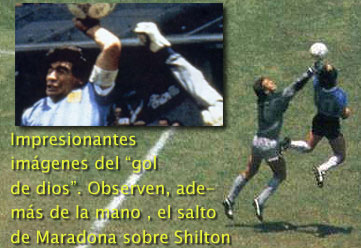
Closer to our memory is the Mexico ’86 World Cup. The one where Maradona blossomed, giving a masterclass of good football in the most individualistic sense imaginable.
Argentina and England met again on the pitch, but this time among the 22 players was Diego Armando Maradona.
In front of more than one hundred thousand spectators at the Azteca Stadium, he not only scored that goal with his hand—which on television still looks blurry, but in the images, as we can see above, it becomes clear that the goalkeeper came out late and Maradona used his hand, albeit making a prodigious jump.
In addition, as we say, he scored what is now known in history as the ‘Goal of the Century‘. Maradona took the ball in his own half, dribbled past five Englishmen, and after dodging goalkeeper Shilton, scored his team’s second goal.
Mexico became the first country to organize the Football World Cup twice. A World Cup in which Argentina prevailed over Rummenigge’s Germany. Revenge would come as soon as time allowed, at the very next World Cup.

We saw the Mexican sombrero again on the mascot, Pique, although social reality imposed other symbols in this World Cup, so much so that Pique was overshadowed by the girl ‘Chiquitibum’, embodied by actress Mar Castro in a television commercial.
A somewhat ridiculous record was starred by the Polish player Wladyslaw Zmuda, who played seven minutes against Brazil just to equal Uwe Seeler’s record for matches played in a World Cup. The sad part is that Zmuda entered the pitch when his team was losing 4-0 to Brazil in a round of 16 match. Four World Cups were also played by Pelé, Diego Armando Maradona, Ronaldo, and Oliver Kahn.
Another sad anecdote is that this World Cup produced the fastest sending-off in World Cup history; Uruguayan José Batista saw the red card at the 55-second mark of the match against Scotland, thus becoming the quickest expulsion.
Mexico 1986. Results
1. Argentina
2. Federal Republic of Germany
3. France
4. Belgium
adidas Golden Ball: Diego MARADONA (ARG)
adidas Golden Boot: Gary LINEKER (ENG)
Best Young Player: Enzo SCIFO (Belgium)
FIFA Fair Play Award: Brazil
The Final in goals: Argentina 3 – Germany 2
Italy 1990 World Cup History

And the rematch arrived. Germany returned to the top of football prestige after the defeat in the ’86 World Cup final against Argentina and the ’82 Spain final against the ‘azzurra’.
The final was stamped with controversy, as Germany won by scoring in the 85th minute, following a controversial penalty converted by Brehme to lift the third German World Cup.
Among the anecdotes is the spit from Frank Rijkaard towards Völler. It was the 21st minute of the Netherlands-West Germany match. Both were sent off.
On a political level, in Italy ’90, Yugoslavia, Czechoslovakia, West Germany, and the Soviet Union played their last World Cup. The decade of the 90s had disintegrations and reunifications in store for them.
The so-called ‘Indomitable Lions’ became the first African team to reach the quarter-finals of a World Cup, although Cameroon was tragically eliminated by the English team with a goal from Gary Lineker in extra time.
The Italy ’90 Mascot: Ciao

The mascot for Italy ’90 was named Ciao. It was a cubic model colored like the Italian flag. Its head: a classic football.
Beckenbauer became the first person in history to be a world champion as both a captain (1974 World Cup) and as a coach (1990).
Italy 1990. Results
1. Federal Republic of Germany
2. Argentina
3. Italy
4. England
adidas Golden Ball: Salvatore SCHILLACI (ITA)
Best Young Player: Robert PROSINECKI (CRO)
FIFA Fair Play Award: England
The Final in goals: Germany 1 – Argentina 0
United States 1994 World Cup History

FIFA’s slogan was to relaunch, or launch, the sport of football, soccer, in the gigantic United States of America. A commercial policy that ultimately hasn’t been truly useful; although the US national team is present in Football World Cups, the sport as such has not caught on or replaced classic American football.

This is the face of Spanish player Luis Enrique (not that he is usually more graceful), after Tassotti’s elbow. The match was tied, and the play should have been punished with a penalty and a red card. This play shows how many interests move the destiny of a national team. Teams like the Italian one are forgiven without much shame.
World Cups can crown a career, or conversely, ruin a player, as is the case of Roberto Baggio’s mistake in the final against Brazil, which ended up handing the World Cup to Brazil.
The Bulgarian Hristo Stoichkov and the Russian Oleg Salenko were the top scorers, netting six goals each. But if any memory is brought to mind by this World Cup, it is the stupid and grotesque murder by a fan of the Colombian defender Andrés Escobar, who was assassinated a few days later after scoring an own goal.
The mascot was Striker the dog, designed by Warner Brothers Animation Studios

United States 1994. Results
1. Brazil
2. Italy
3. Sweden
4. Bulgaria
adidas Golden Ball: ROMÁRIO (Romário de Souza Faria) (BRA)
adidas Golden Boot: Oleg SALENKO (RUS), Hristo STOICHKOV (BUL)
Yashin Award for Best Goalkeeper: Michel PREUDHOMME (BEL)
Best Young Player: Marc OVERMARS (NED)
FIFA Fair Play Award: Brazil
FIFA Award for the Most Entertaining Team: Brazil
France 1998 World Cup History
Zidane defined the final before halftime. He had scored two goals that confirmed his talent for the historical iconography of football, before delivering the headbutt to Materazzi as we will see in the next World Cup. But the final was played against the best of Brazil. Petit defined the inevitable victory.

Among the names of this World Cup we find Davor Suker; the Croatian striker and later Real Madrid player was the top scorer with six goals. He scored one more than the Dutchman Dennis Bergkamp, the Argentine Batistuta, and the Italian Vieri.
In this World Cup, the so-called ‘golden goal’ was put into practice. Blanc, the French player, has the honor of being the first goalscorer in this regard; France and Paraguay were playing, and Blanc’s goal granted the Gauls a pass to the quarter-finals.
Matthäus equaled the record of five World Cups played held by Mexican goalkeeper Antonio Carbajal and surpassed the mark for most matches played with 25, four more than Diego Armando Maradona, Uwe Seeler, and the Pole Zmuda. He also left the record for minutes on the pitch at a staggering 2,021.
The qualifying phase saw the biggest goal victory in history: Iran scored 17 goals to zero against the Maldives.
The France 1998 World Cup mascot was Footix

The mascot was Footix; the name was chosen by French fans. It was a red and blue rooster holding the official World Cup ball under its wing, the “Tricolore,” decorated in white and red, just like the French flag, made by Adidas.
In this championship, FIFA declared 3.5 billion dollars in profits.
France 1998. Results
1. France
2. Brazil
3. Croatia
4. Netherlands
adidas Golden Ball: RONALDO (BRA)
adidas Golden Boot: Davor SUKER (CRO)
Yashin Award for Best Goalkeeper: Fabien BARTHEZ (FRA)
Best Young Player: Michael OWEN (ENG)
FIFA Fair Play Award: England, France
FIFA Award for the Most Entertaining Team: France
Korea and Japan 2002 World Cup History

It was the first time the organization of a World Cup fell to two nations. It was the championship of Ronaldo. Brazil and Germany, two of the candidates, faced each other in a final that the Brazilians resolved with two goals past goalkeeper Oliver Kahn. It was the fifth World Cup for the ‘canarinha’ team.
The political-sporting anecdote was provided by Silvio Berlusconi, already in Italian power as Prime Minister. Reminiscent of the dictator Benito Mussolini, he sent off his national team’s players saying: “If you come back earlier than expected, we’ll put you in jail.”
The fastest goal in World Cup history was scored in this championship; it was the work of the Turk Hakan Sukur, who needed only 10 seconds against South Korea.
Another name that entered the history of records is Cafú, who played in three consecutive finals.
The Korea and Japan 2002 World Cup mascot

The mascot of this World Cup has its explanation if we consider the mentality of the host countries. Without much shame, they introduced a Pokémon-style trio.
It seems they are “celestial beings” who came down to Earth with the intention of watching the World Cup. Their names were: ATO, orange in color and the official mascot, MIK, purple, and KAZ, blue, who snuck onto the trip and arrived with him.
Korea and Japan 2002. Results
1. Brazil
2. Germany
3. Turkey
4. Republic of Korea
adidas Golden Ball: Oliver KAHN (GER)
adidas Golden Boot: RONALDO (BRA)
Yashin Award for Best Goalkeeper: Oliver KAHN (GER)
Best Young Player: Landon DONOVAN (USA)
FIFA Fair Play Award: Belgium
FIFA Award for the Most Entertaining Team: Republic of Korea
Germany 2006 World Cup History

On the pitch, the grand final is contested. A twilight Zinedine Zidane falls into the trap of provocation and knocks down the Italian Marco Materazzi with a headbutt to the chest. It was the preamble to the great Gallic tragedy; something tried to tell us that Italy would win the Germany ‘2006 World Cup, their fourth crown.
Part of the Italian triumph was due to goalkeeper Gianluigi Buffon and captain Fabio Cannavaro. The goalkeeper only conceded two goals, one an own goal and the other a penalty.
It is estimated that more than three million spectators attended the matches, which were followed by an approximate audience of 30 billion viewers.
We were able to witness the rise of the Portuguese Cristiano Ronaldo, who led his national team to rank among the top four, something that hadn’t happened for Portugal since 1966.
As a negative anecdote, we find that in the match played between Germany and Argentina, eternal rivals, where Germany eliminated Argentina in the penalty shootout, a fight broke out between the players: Cufré, Maxi, and Frings were penalized for their lamentable display of kicking. Another highlight is the goalless draw that Trinidad and Tobago, a very modest team, achieved against Sweden in their World Cup debut.
The Germany 2006 World Cup mascot. Goleo

The mascot was notably modernized. This felt or plush lion named Goleo was a creation of the Jim Henson Co., the same people behind Sesame Street and The Muppets. At 2.30 meters tall, he had an internal LCD monitor connected to an external camera so the actor could navigate. The lion was accompanied by the talking ball Pille, which was operated by remote control.
Germany 2006. Results
1. Italy
2. France
3. Germany
4. Portugal
adidas Golden Ball: Zinedine ZIDANE (FRA)
adidas Golden Boot: Miroslav KLOSE (GER)
Yashin Award for Best Goalkeeper: Gianluigi BUFFON (ITA)
Best Young Player: Lukas PODOLSKI (Germany)
FIFA Fair Play Award: Spain, Brazil
FIFA Award for the Most Entertaining Team: Portugal
South Africa 2010. The Year of Spain

It was said that South Africa should have organized the 2006 World Cup, the ones held in Germany. Those things that are discussed in offices. Well, you know…
Blatter imposed the rotation of continents regarding the hosting of football world cups, and the struggle to win the bid was decided between South Africa, Morocco, Egypt, Tunisia, Libya, and Nigeria. Only South Africa, Morocco, and Egypt officially presented their candidacies, which, as we all know, the South African country won.
It is said that the economic investment exceeded one billion dollars to equip the country with good football stadiums. There would be 31 countries competing to win the World Cup.
It was not France’s year, as they expelled Anelka from the training camp, a consequence of serious internal problems. Nor was it Argentina’s year; with Maradona as coach, he didn’t see glory like he did when he was a player.
The semi-finals left the four best teams of the tournament. Spain, the clear favorite after winning the European Championship two years earlier. The Netherlands, who had just beaten the perennial candidate Brazil, but who faltered in defense.
Spain, with a team that had overcome the stigma of just playing with race and courage, playing with technique, touching the ball, with that famous tiki-taka that has enamored many, and which has also ended up tiring others, based on the FC Barcelona youth academy and exceptional players like the eternal Real Madrid’s Iker Casillas, Sergio Ramos, or Xabi Alonso, but with a generation of extraordinary footballers in all lines and a coach well-forged in triumph like Vicente del Bosque, ended up putting an end to the Dutch dream and to the bad luck, plus the occasional refereeing robbery (let’s remember the USA or Korea and Japan World Cups) that always left them at the gates of nothing.
Robben stood in front of Casillas and missed. Iniesta stood in front of Stekelenburg and did not fail…
South Africa 2010. Results
1. Spain
2. Netherlands
3. Germany
4. Uruguay
Zakumi. That was the name of the South Africa World Cup mascot, a leopard dressed in the colors of the South African national football team.

Brazil 2014 World Cup History
The World Cup returned to the “country of football” 64 years after that tragic ‘Maracanazo’. The expectation was massive, and Brazil started as the great favorite to be crowned at home, but history had an even bigger trauma prepared for them: the famous ‘Mineirazo’. In the semi-finals, an overwhelming Germany destroyed the host with a humiliating 7-1, a result that shocked the whole world.
The grand final at the Maracanã stadium pitted a solid Germany against an Argentina led by a Lionel Messi who was seeking his first world title. The match was tense and very tactical, resolving in extra time thanks to a solitary goal by Mario Götze in the 113th minute, granting Germany its fourth star and making it the first European team to win a World Cup on the American continent.
The anecdote of the tournament, besides Uruguayan Luis Suárez’s bite on the Italian Chiellini, was the first-time use of vanishing spray by referees to mark the distance on defensive walls and the goal-line technology (Hawk-Eye).
The mascot of the Brazil 2014 World Cup: Fuleco
The representative of this World Cup was Fuleco, a three-banded armadillo (an endangered species in Brazil). His name was a fusion of the words Football and Ecology, aiming to raise awareness about the environment.
Brazil 2014. Results
1. Germany
2. Argentina
3. Netherlands
4. Brazil
adidas Golden Ball: Lionel MESSI (ARG)
adidas Golden Boot: James RODRÍGUEZ (COL) – 6 goals
Golden Glove: Manuel NEUER (GER)
Best Young Player: Paul POGBA (FRA)
Russia 2018 World Cup History
The World Cup in Russia marked a before and after in the history of refereeing: it was the tournament where VAR (Video Assistant Referee) officially debuted. This technology brought with it a historical record of penalties awarded (29 in total).
France, with a golden generation led by Antoine Griezmann and the explosion of a very young Kylian Mbappé, was crowned champion for the second time in its history, twenty years after its 1998 triumph. In the final, they defeated the surprising Croatia of Luka Modrić 4-2, a team that won the hearts of the fans after overcoming three consecutive extra times to reach the last match.
Among the big surprises, the early elimination of Germany, the defending champion, in the group stage after losing to South Korea stood out, confirming the famous “champion’s curse” that had been haunting European winners in the 21st century.
The mascot of the Russia 2018 World Cup: Zabivaka
The chosen mascot was Zabivaka, which means “the one who scores” in Russian. He was a very friendly anthropomorphic wolf wearing sports goggles, chosen by popular vote, beating a tiger and a cat.
Russia 2018. Results
1. France
2. Croatia
3. Belgium
4. England
adidas Golden Ball: Luka MODRIĆ (CRO)
adidas Golden Boot: Harry KANE (ENG) – 6 goals
Golden Glove: Thibaut COURTOIS (BEL)
Best Young Player: Kylian MBAPPÉ (FRA)
Qatar 2022 World Cup History
An atypical World Cup full of firsts. For the first time in history, the World Cup was held in the Middle East and was played in winter (November and December) to avoid the suffocating temperatures of the Qatari summer. It was also the tournament that definitively consecrated Lionel Messi in the Olympus of football.
The grand final between Argentina and France is already considered by many to be the best final in World Cup history. After a heart-stopping 3-3 draw (with two goals from Messi and a spectacular hat-trick from Mbappé), Argentina took the title in the penalty shootout thanks to the heroic saves of Emiliano “El Dibu” Martínez.
The tournament also left one of the most beautiful stories in modern football: Morocco became the first African national team and the first from the Arab world to reach the semi-finals, eliminating powerhouses like Spain and Portugal along the way.
The mascot of the Qatar 2022 World Cup: La’eeb
Breaking with the tradition of using animals, Qatar presented La’eeb (which in Arabic means “super-skilled player”). It consisted of a traditional floating and smiling turban (kufiyya) that, according to the organization, came from a “mascot metaverse”.
Qatar 2022. Results
1. Argentina
2. France
3. Croatia
4. Morocco
adidas Golden Ball: Lionel MESSI (ARG)
adidas Golden Boot: Kylian MBAPPÉ (FRA) – 8 goals
Golden Glove: Emiliano MARTÍNEZ (ARG)
Best Young Player: Enzo FERNÁNDEZ (ARG)
👉 And if you are already thinking about the future, don’t miss our special article featuring the new 48-team format and the 2026 World Cup quiz.