The black monolith from Stanley Kubrick’s “2001: A Space Odyssey” is one of the most iconic and enigmatic images in the history of cinema. Far from being a simple object, it functions as a powerful, multi-layered metaphor that addresses human evolution, contact with a higher intelligence, and the limits of knowledge. Its origin is a confluence of literary science fiction, philosophy, and minimalist art, all orchestrated by Kubrick’s meticulous vision.
Literary Origins: From “The Sentinel” to “2001”
The genesis of the monolith can be found in Arthur C. Clarke’s 1951 short story, “The Sentinel.” In that story, a transparent, pyramidal artifact is discovered on the Moon, left by an ancient extraterrestrial civilization as an alarm to signal when humanity achieved space travel.
Watch our latest Shorts!
For “2001,” Kubrick and Clarke collaborated closely, transforming the pyramid from “The Sentinel” into the now-famous black, rectangular monolith. This design decision was crucial. While the novel Clarke wrote concurrently with the film offers more explanation about the monolith’s function as a tool of an advanced civilization, Kubrick opted for a much more ambiguous and visual approach. Initially, other shapes were considered, such as a cube or a transparent slab, but they ultimately settled on the black slab for its mystery and powerful visual presence.
Interpretations and Symbolism: A Catalyst for Evolution
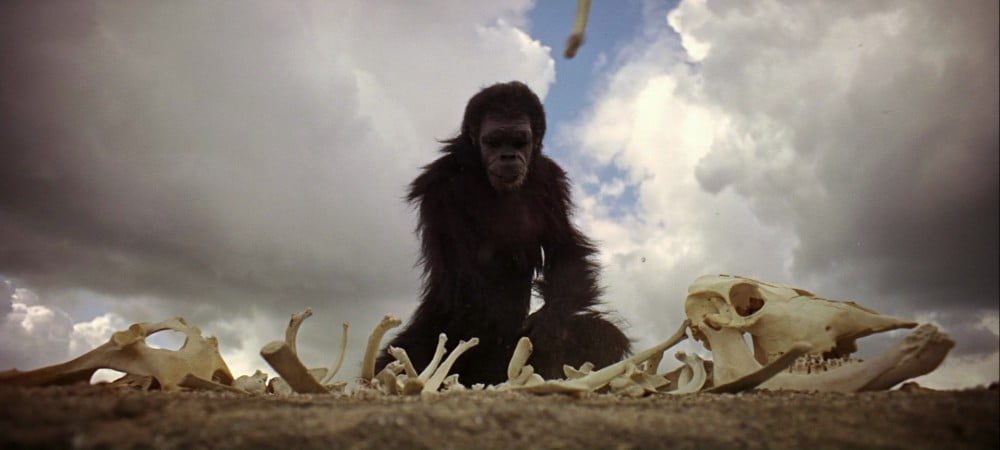
The monolith appears at key moments in human history, acting as a catalyst for evolutionary leaps. Its first appearance, at the dawn of man, inspires a group of hominids to use tools—a fundamental step in their development. Millions of years later, a monolith unearthed on the Moon emits a signal toward Jupiter, marking a new milestone in humanity’s technological progress.
The interpretations of what the monolith represents are varied and often complementary:
- Extraterrestrial Intelligence and Guided Evolution: The most direct interpretation is that the monolith is a tool from an advanced alien civilization that guides and accelerates the evolution of intelligent life across the universe.
- The Unknown and the Sublime: Its perfect geometric shape and impenetrable blackness evoke a sense of the sublime—something that is both awe-inspiring and terrifying. It represents that which lies beyond human comprehension.
- Technology and the Quantum Leap: The monolith can be seen as a metaphor for knowledge itself and the great technological breakthroughs that propel humanity forward, often in unpredictable and transformative ways.
- A Projection of Consciousness: Some analyses suggest the monolith could be a representation of the cinema screen itself—an object that invites us to contemplation and the expansion of our own consciousness.
Philosophical and Artistic Influences: Nietzsche and Minimalism
The film is deeply imbued with the philosophy of Friedrich Nietzsche, and the monolith plays a central role in this reading. The narrative follows the transformation of humanity, from the “ape” to Nietzsche’s “superman” (Übermensch). The “Star Child” at the end of the film, following David Bowman’s encounter with the monolith, symbolizes this new evolutionary stage.
From an artistic perspective, the monolith’s design is heavily influenced by the minimalist art movement that gained prominence in the 1960s. The work of sculptors like John McCracken, known for his simple, geometric planks of colored fiberglass resin, has been cited as a possible direct inspiration. McCracken himself, a science fiction fan, did not dismiss the idea that his work might have influenced the design. The monolith’s formal simplicity, stripped of any ornamentation, gives it a powerful and universal presence, in line with the principles of minimalism that seek the essence of form.
Ultimately, Stanley Kubrick’s monolith has no single answer. Its power lies precisely in its ambiguity and its ability to evoke a multitude of ideas about our past, our future, and our place in the cosmos. It is a cinematic work of art that, much like its enigmatic protagonist, invites reflection and the expansion of the mind.
Your Ticket to More Cinema Stories
Don’t stop with this analysis. We have an entire film archive waiting for you.


