We tend to imagine the history of universal literature as a solemn process: melancholic men and women locked in dusty offices under kerosene light, weaving masterpieces in academic whispers. However, the reality of the Lost Generation in 1920s Paris was radically different. The giants who changed the course of modern letters did not live in ivory towers; they lived in street-level mud, with wine flowing endlessly and knuckles frequently bruised. Among all the improbable and chaotic friendships of that golden era, none surpasses the alliance forged between Ernest Hemingway and James Joyce—a partnership as fascinating as it is uproarious, combining the most complex literary avant-garde with the cheapest brawl in the Latin Quarter.
In the early 1920s, Paris was the cultural epicenter of the world. James Joyce was already a consecrated and almost mythical literary celebrity after shaking the foundations of Western culture with the publication of Ulysses. Yet, at close range, Joyce was far from a physical warrior: he was petite, fragile, extremely refined in his attire, and suffered from severe vision problems that left him nearly blind in one eye, forcing him to wear thick glasses and eye patches.
Watch our latest Shorts!
In the opposite corner of the ring stood Ernest Hemingway. In his early twenties, the future author of The Old Man and the Sea was working as a foreign correspondent in Europe. He was a stocky, muscular young man obsessed with boxing, bullfighting, and firearms, possessing a volcanic temperament and a constant need to prove his manhood at every turn.
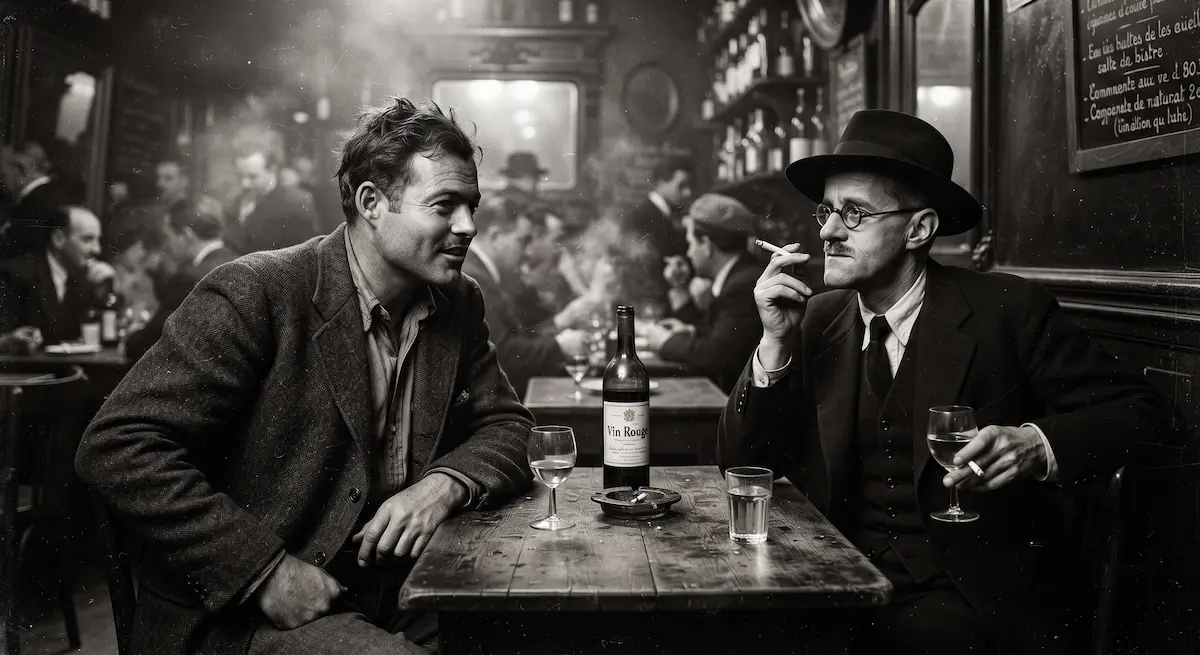
Despite their abysmal differences, both writers clicked instantly. They shared a deep mutual respect for uncompromising prose, but what truly united their paths were the endless, alcohol-fueled nights across Parisian bistros.
The Brawl Mechanism: “Hit Him, Hemingway!”
Joyce and Hemingway’s nocturnal outings quickly became urban legend among the French capital’s bohemian circles. The Irish author suffered from a peculiar alcoholic transformation: as white wine or Burgundy began to take effect, the timid, introverted intellectual completely vanished, giving way to an untiring brawler.
“Joyce never picked a fight out of cowardice, but out of a blind faith that the literary universe had to defend itself with punches… or rather, by getting his personal bodyguard to do the dirty work.”
As Hemingway himself recounted in his memoirs and letters, tavern dynamics usually followed a precise script. Stimulated by alcohol, Joyce would begin staring fixedly at stocky patrons, drunken sailors, or grumpy locals, tossing cryptic remarks or veiled insults until igniting an unmanageable argument.
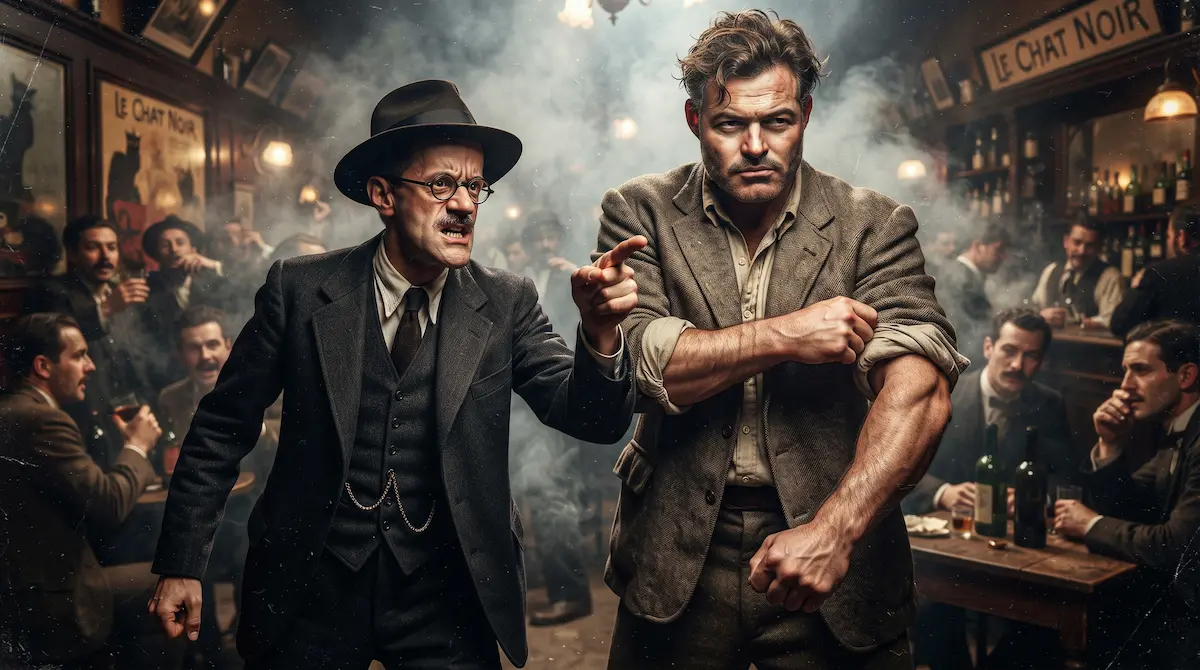
When tempers flared, chairs scraped back, and fists prepared to fly, the climactic moment of the night arrived: the fragile James Joyce would slip away with feline agility, literally hide behind Hemingway’s back, point at the furious opponent, and scream at the top of his lungs:
“Hit him, Hemingway! Hit him!”
Immediately, the young correspondent assumed his role as literary protector, resolving the dispute with left hooks, separating the thugs, or imposing his commanding physical presence to rescue the creator of Dubliners himself.
Street Bohemianism and Literary Creation
Far from being ashamed of these tavern brawls, Hemingway recalled these anecdotes with a mix of admiration and humor. To him, Joyce possessed unbreakable intellectual courage—even if that courage consisted of provoking physical fights he could not defend himself against due to his severe visual impairment.
These street experiences, the smoke of clandestine bars, discussions on linguistic purity, and the colossal hangovers of interwar Paris directly fueled both authors’ narrative sensibilities. They proved that great literature does not stem solely from contemplative isolation, but from absolute immersion in the contradictions, miseries, and passions of real life.
The Legacy of an Unimaginable Friendship
Recalling these stories humanizes figures that time has turned into untouchable marble statues. James Joyce and Ernest Hemingway were, above all, men of their time: complex, brilliant, amusing, and deeply imperfect.
So, the next time you dive into the pages of a great 20th-century novel, remember that behind that flawless prose often lies the shadow of a wild night in Paris, a cheap glass of wine, and a terrified blind writer screaming behind a giant ready to throw punches.