The Art of Pausing
How ancient wisdom survived to save you from the digital sedentary lifestyle
The irony of human evolution is fascinating. For thousands of years, our bodies were designed for constant movement: hunting, gathering, building. Today, in the era of maximum efficiency, the pinnacle of productive work consists of sitting in front of a glowing screen for eight to ten hours a day.
Watch our latest Shorts!
The result is what medical experts already classify as the silent pandemic: technological sedentarism. "Text neck", carpal tunnel syndrome, lumbar compression, and chronic mental fatigue are not signs of weakness; they are the cry of a biomechanical body trapped in a static environment.
The Clash of Two Worlds
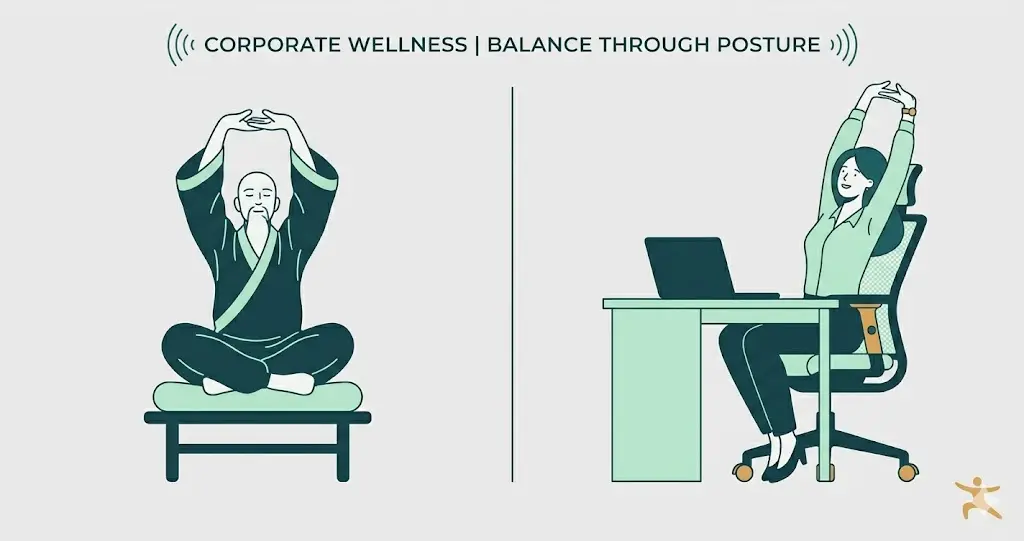
This is where history offers us an unexpected lifeline. In ancient China (around the 12th century), Taoist masters and warrior monks faced a similar problem, albeit for different reasons. Their long days of static meditation caused muscle atrophy and poor circulation. Their solution was not to stop meditating, but to develop precise biomechanical movement systems to "reset" the body.
The Ba Duan Jin (Eight Pieces of Brocade) or the fundamental principles of Tai Chi Chuan were born as physical technology. Movements designed to expand the rib cage, decompress the spine, and oxygenate the brain in just a few minutes.
The Translation to the Modern Office
The brilliance of these classic systems is that they require no equipment, gyms, or sweating. Their core is the balance between tension and relaxation (the concept of Yin and Yang). And this is exactly what a 21st-century office worker needs.
At DeskChi, our job has been to act as translators. We have taken the wisdom of public domain texts, such as the classic treatises of Wang Zongyue or the manuals of Sun Lutang, and removed the martial or mystical veil. We have kept the pure physiology.
- Traction instead of compression: We adapt fluid movements to be performed in an ergonomic chair, relieving the load on the intervertebral discs.
- Diaphragmatic breathing: We guide breathing to deactivate the sympathetic nervous system (the stress and "fight or flight" mode triggered by urgent emails).
- Micro-Habits: We compress complex sequences into 3-minute pills. We are not asking you to change your life; we are asking you to pause for 180 seconds.
Why 3 Minutes? The Science of the Pause
Modern ergonomic studies show that the damage of a sedentary lifestyle is not counteracted by going to the gym for an hour at the end of the day. Joint damage is caused by uninterrupted sustained posture.
Taking a 3-minute active pause every two hours has a greater physiological impact on preventing lower back and neck pain than an hour of strenuous exercise after eight hours of immobility. It is the principle of "Muscle Memory" applied to health: reminding your muscles, several times a day, of their natural length and tension.
Welcome to the new paradigm of corporate wellness. You don't need to get out of your chair to start changing how you feel. You just need to learn the art of pausing.
Test Your Reading Retention
1/10
Great mental workout!